
Last updated August 26, 2026
Free on-site gate assessment - hinges, posts, and your LiftMaster or Nice gate operator checked before anything is quoted
The assessment is free and the quote is the invoice.
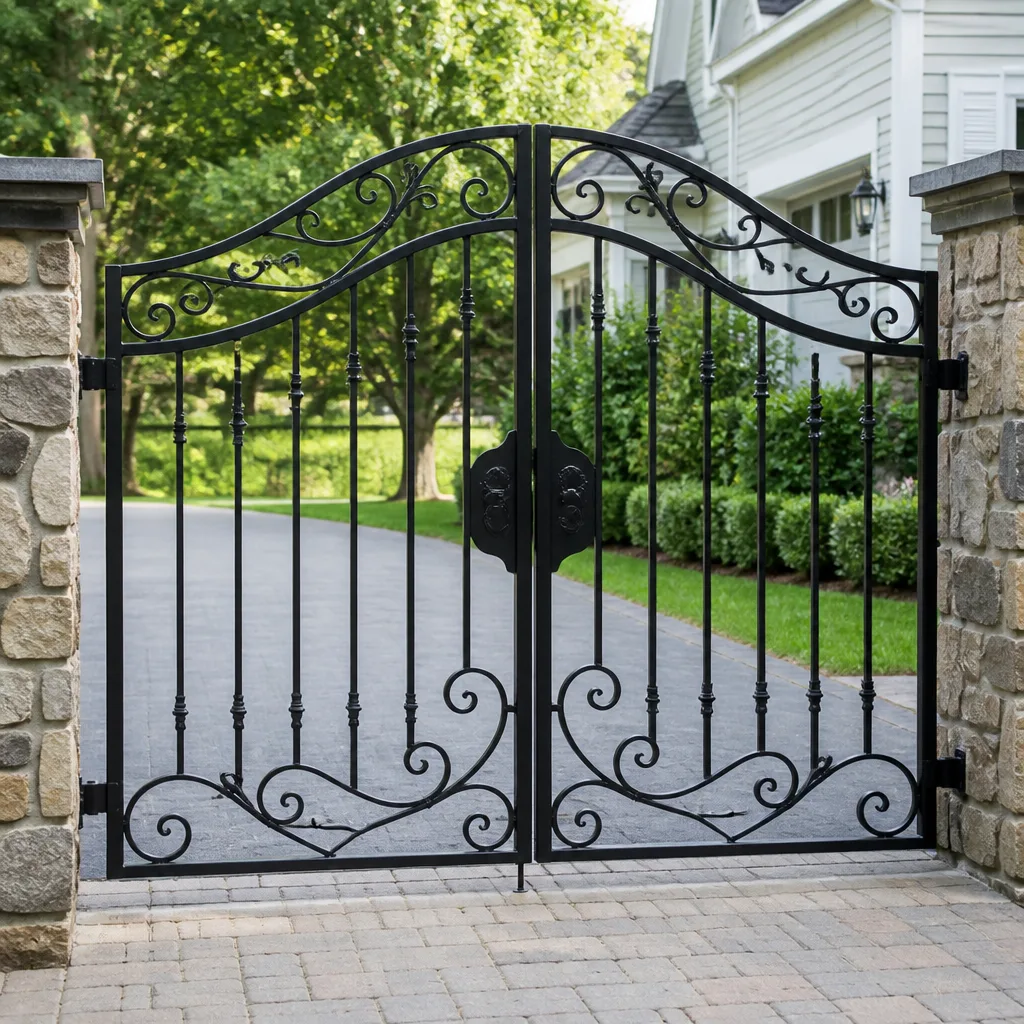
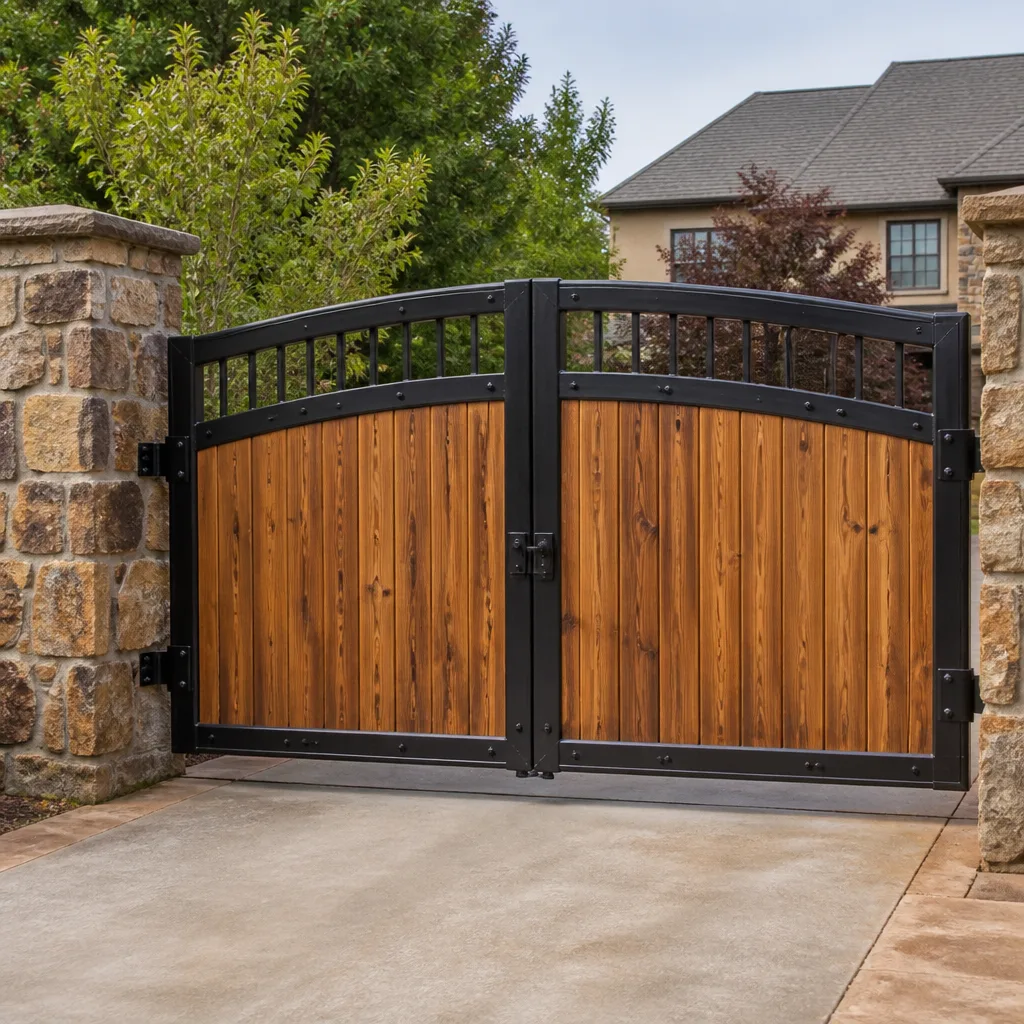
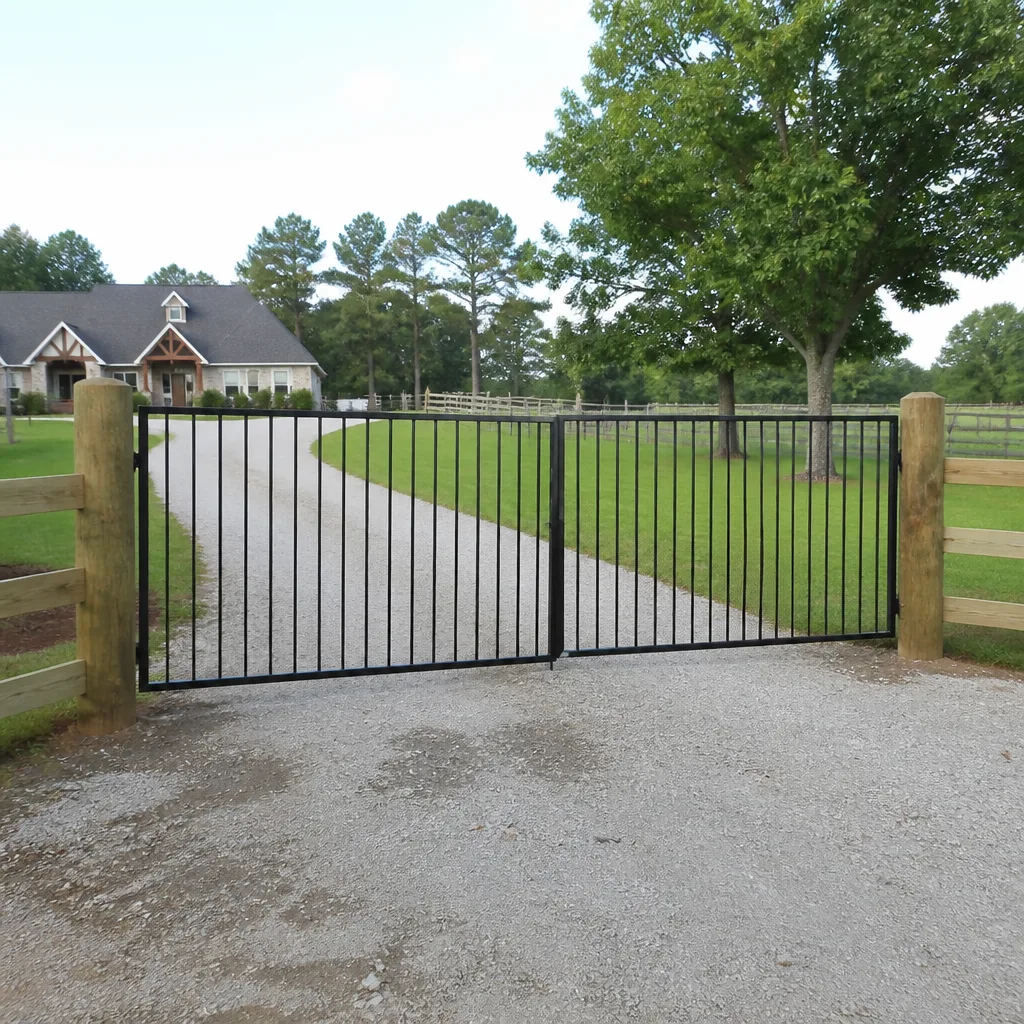
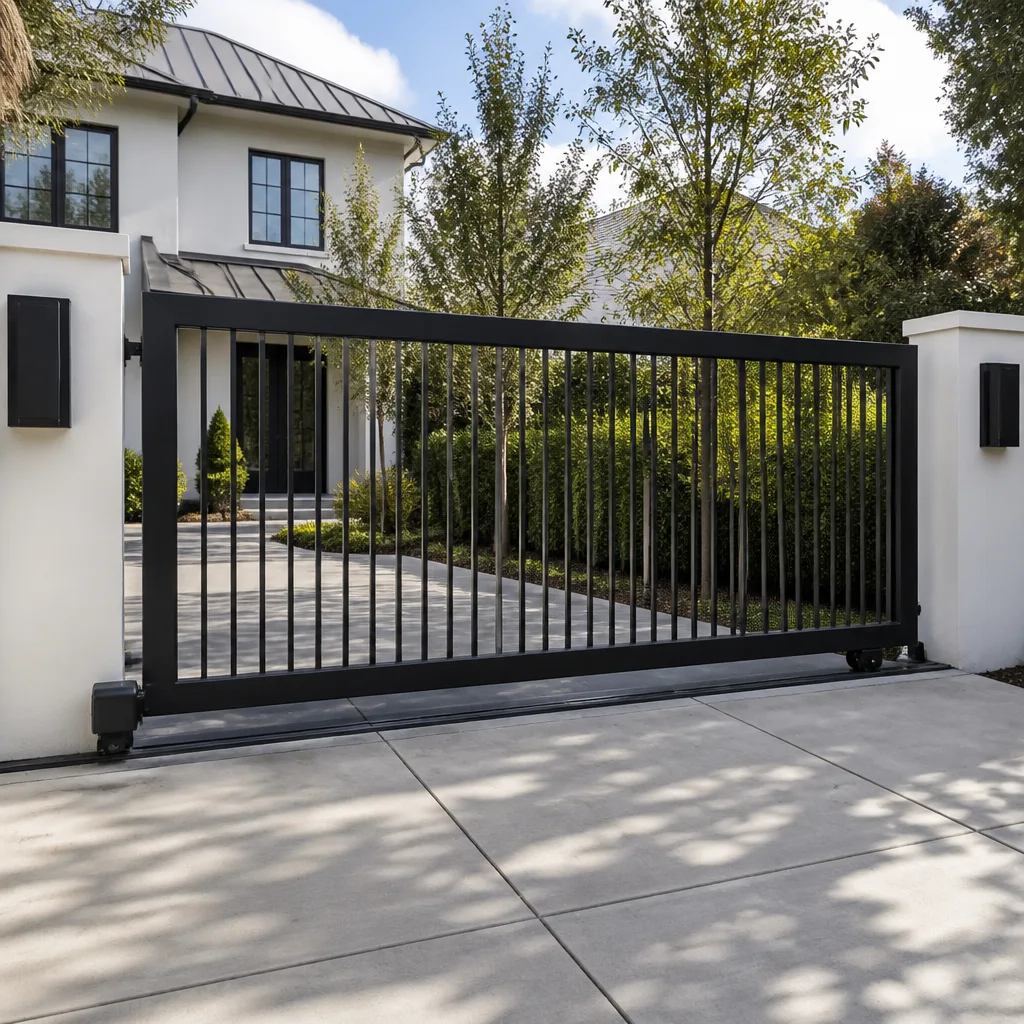
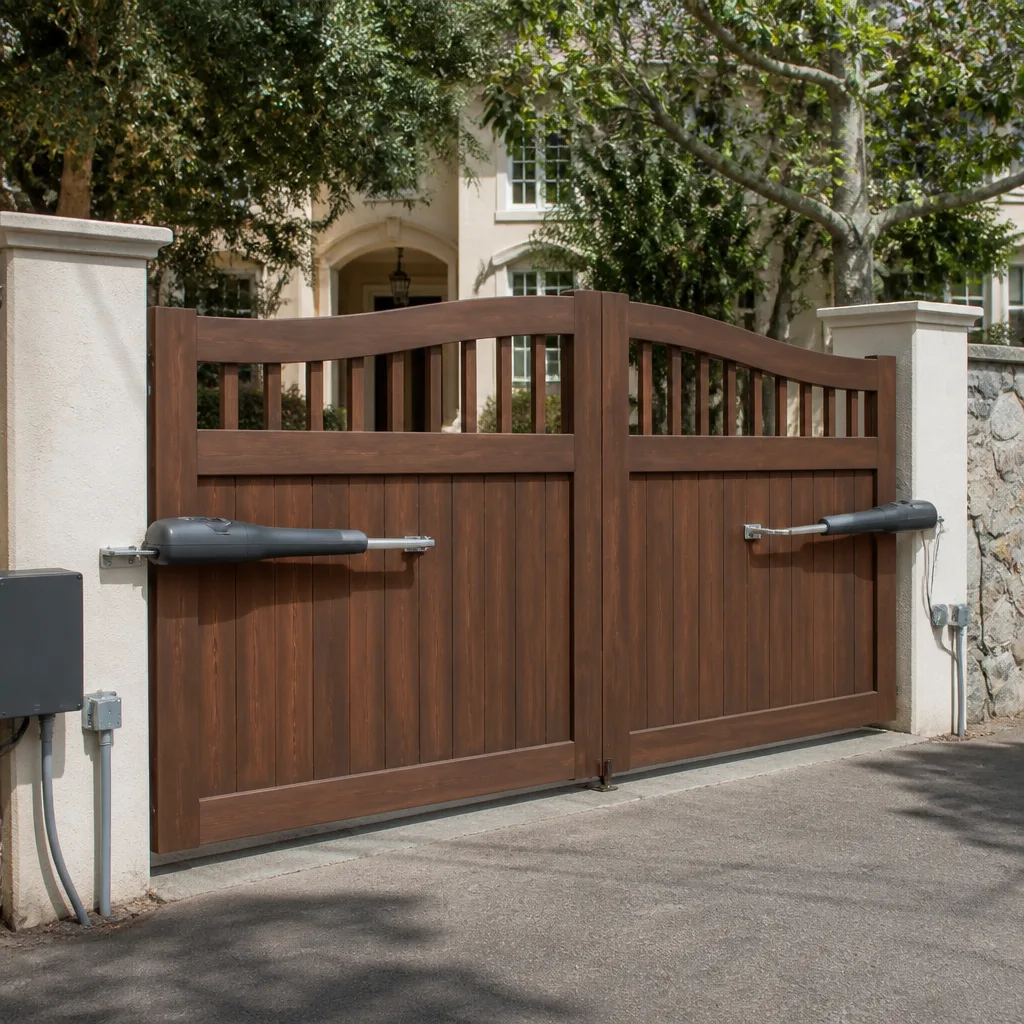
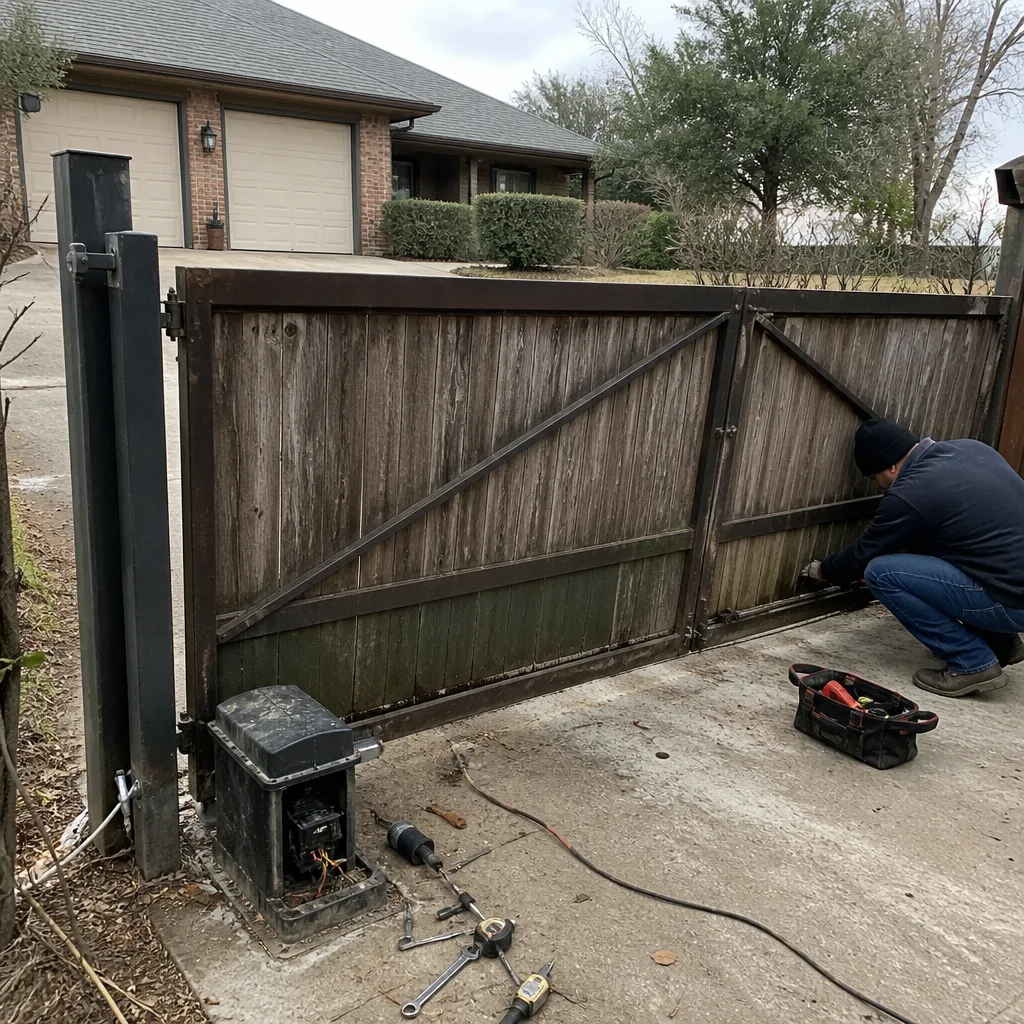 Before
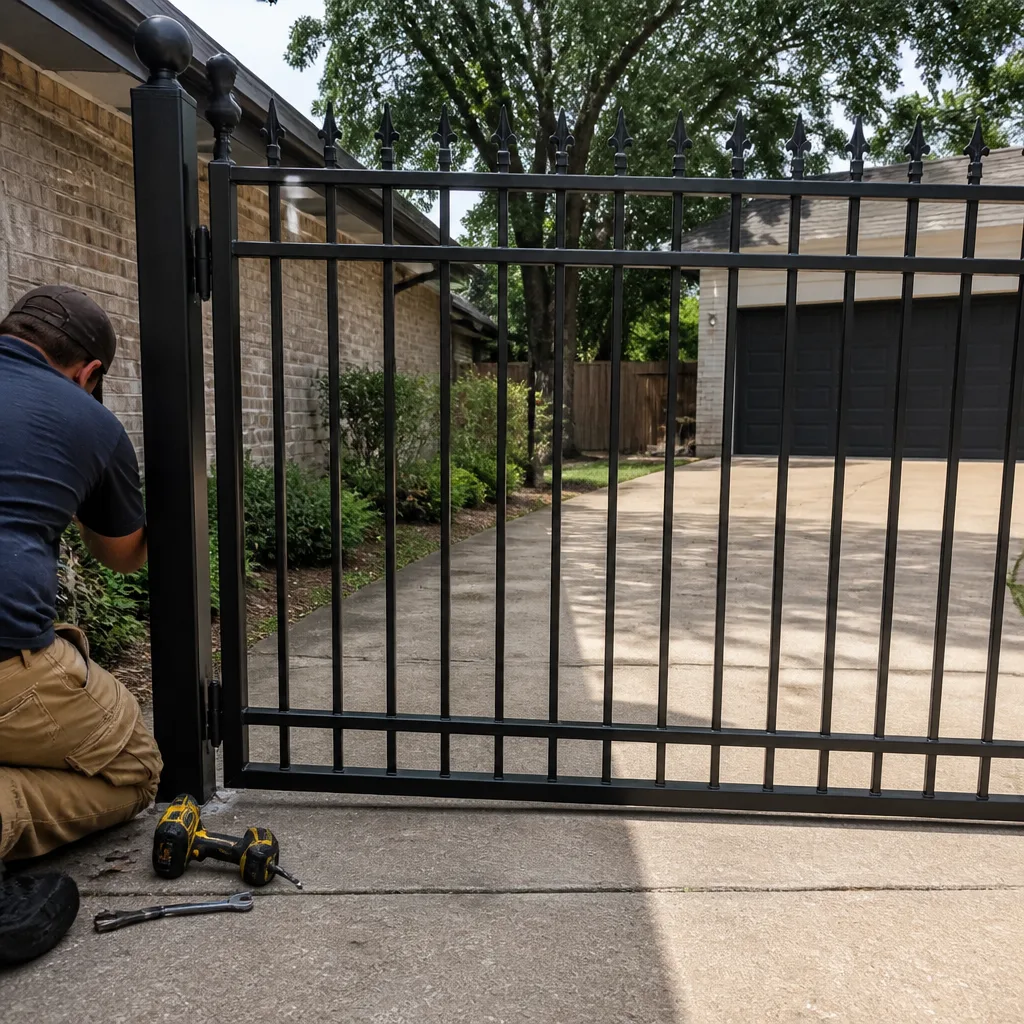 After
After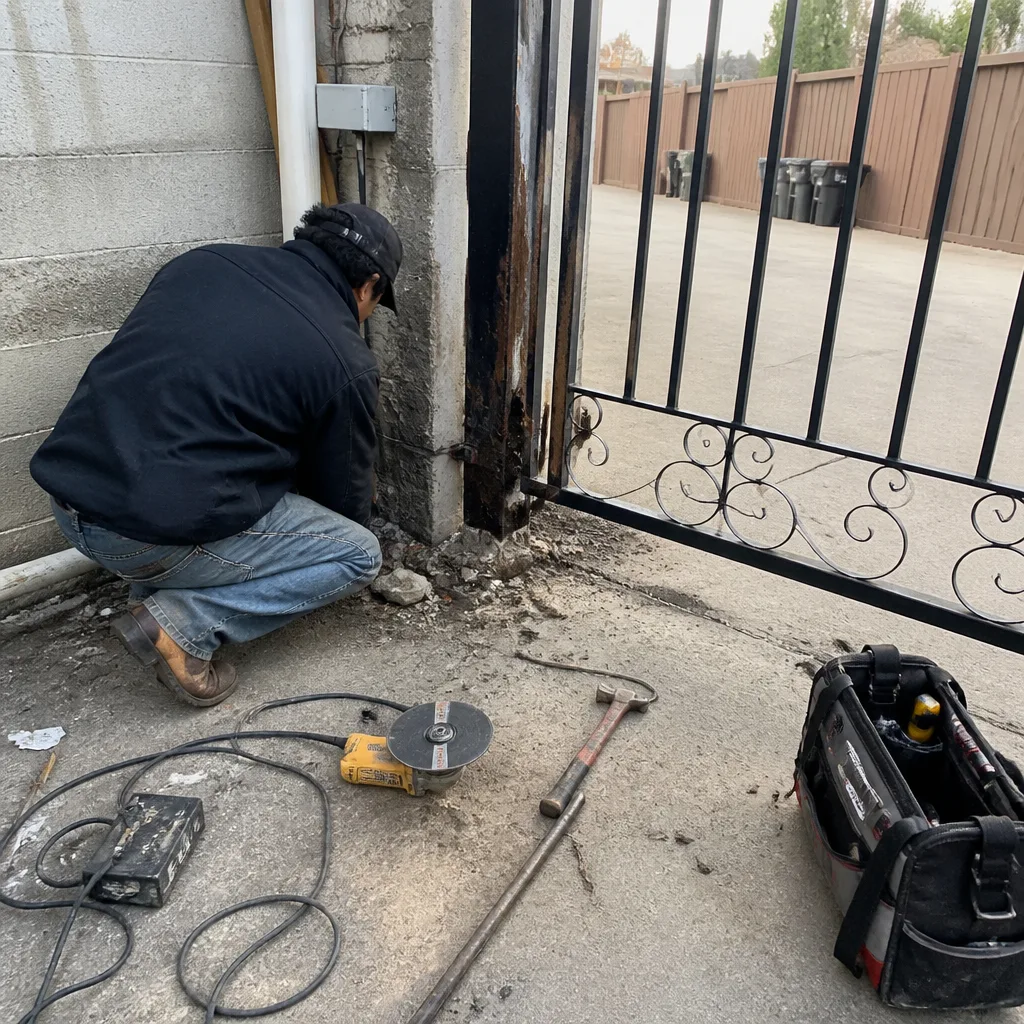 Before
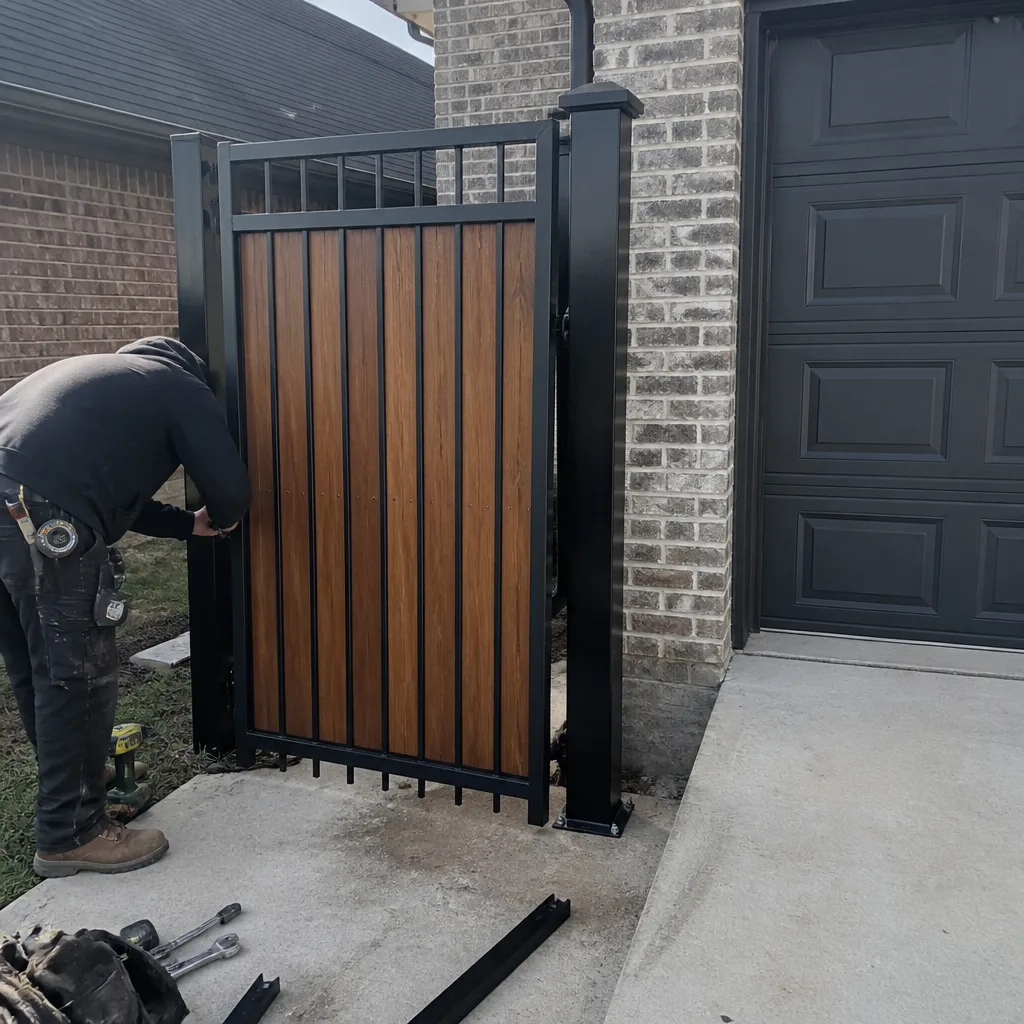 After
After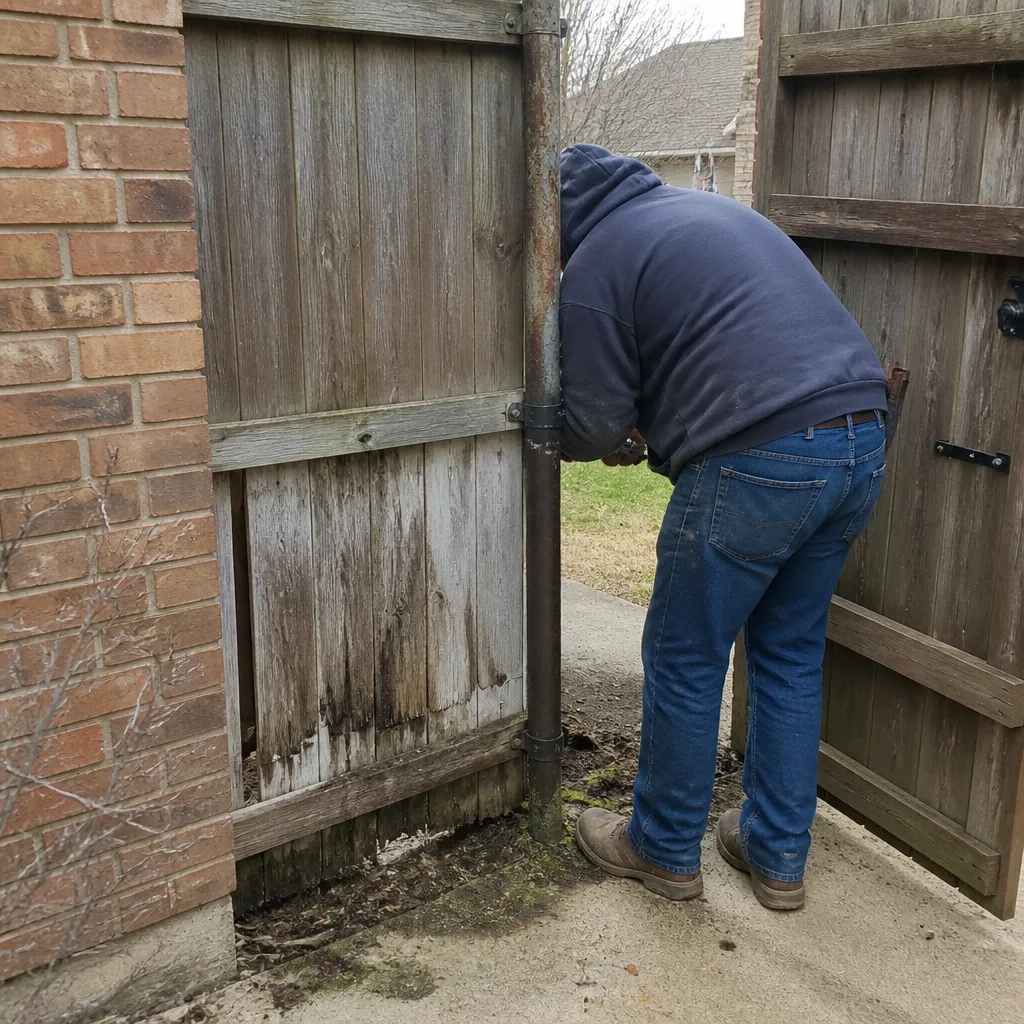 Before
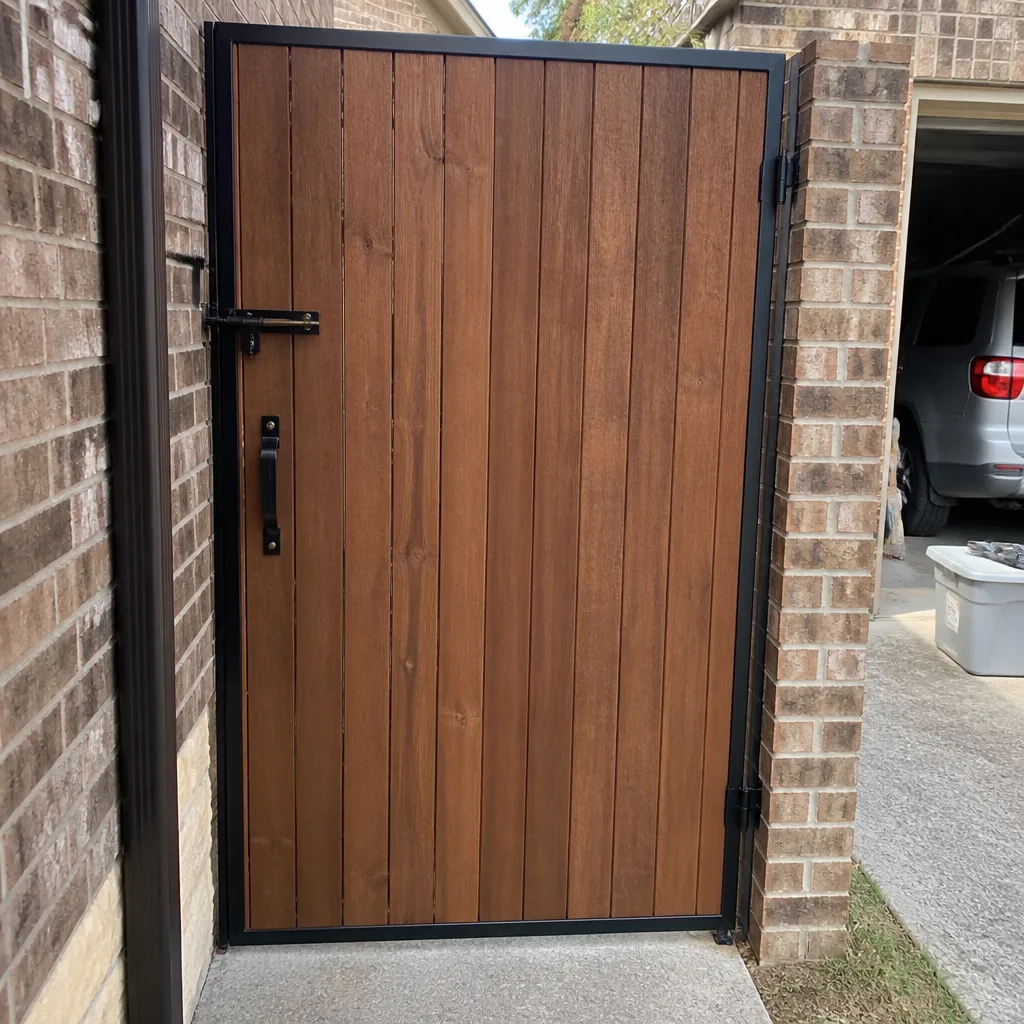 After
AfterThe Complete Guide to Gate Repair in Denton
Here’s a number most gate companies in Denton won’t tell you: roughly seven out of ten automatic gates we’re asked to replace could have been repaired for a couple hundred dollars. The homeowner just didn’t know it yet. They called a company that sells new gates for a living, and that company did what sells. This Gate Repair guide is different. Over the next several minutes, I’ll walk you through it the way I’d explain it to a neighbor across a fence line in Denton, what actually breaks, what it costs, what you can fix yourself, and what you should never touch without a trained hand.
Quick Answer
Gate repair in Denton typically costs between $90 and $400 for common issues like hinge replacement, wheel repair, or opener limit adjustments. Most repairs are completed the same day, and a significant portion of the gates we look at don’t need replacement at all. The three root causes behind most Denton gate failures are soil movement, heat-warped hardware, and neglected opener maintenance. Call (940) 394-8744 for a free estimate and an honest read on whether your gate is worth fixing.
Table of Contents
- The Three Root Causes of Gate Failure in Denton
- What Gate Repair Costs in Denton
- Which Repairs You Can Do Yourself (and Which You Shouldn’t)
- On-Site Welding vs. Bolt-On Patches
- Gate Material Lifespans in North Texas
- How to Document Your Gate Problem for an Accurate Estimate
- Gate Opener and Motor Troubleshooting
- Common Mistakes to Avoid
- When to Call a Professional
- Frequently Asked Questions
The Three Root Causes of Gate Failure in Denton
Every automatic gate that comes into our shop, whether it’s a sagging driveway gate in Robson Ranch or a walk gate that won’t latch in Idiot’s Hill, is fighting the same three enemies. Learn these and you’ll understand more about your gate than most of the people who quote you to fix it.
1. Denton’s clay-heavy soil. North Texas sits on expansive clay that swells when it rains and shrinks when it dries. Your gate posts are set in that soil. When it shifts, the post shifts. A post that moves a half inch at the base translates to a gate that drags two inches at the latch end. In Denton, we see this pattern every summer: late July and August, the ground cracks open, posts heave, and suddenly a gate that worked fine in May is dragging on the driveway. The gate didn’t break. The ground moved under it. Fix the post, and you fix the gate. Gate Repair in Denton almost always starts with a hard look at the post, not the panel.
2. Heat-warped hardware. Denton sees a hundred degree days every summer, and steel expands in that heat. Hinges, brackets, and bolts that were installed snug in March loosen by August. Powder coating breaks down under direct Texas sun, and once moisture gets in, rust follows. We see gates in Argyle and Ponder with hinges that look fine from five feet away but have hairline cracks at the weld point.
3. Neglected opener maintenance. Automatic gate openers have internal parts that wear with use: limit switches, capacitors, drive belts, and battery backup units. Most homeowners never touch their opener until the gate stops moving. Then they assume the motor is dead. In our experience, about half the “dead openers” we’re called to look at in Denton just need a limit adjustment, a cleaning, or a $40 capacitor. The motor on a Mighty Mule or DoorKing opener is built to run for years. Its supporting parts are not.
Here’s the point: none of these are reasons to replace a gate. They’re reasons to repair it correctly, at the source of the problem.
What Gate Repair Costs in Denton
We believe in saying the price out loud before you have to ask. Here’s what you should expect to pay for common gate repairs in Denton County as of 2025. For a deeper look, see our Gate Repair Cost Breakdown: The Denton Homeowner’s Reference for 2026. These ranges reflect what we charge, and they’re honest numbers you can use to compare other quotes.
- Hinge replacement (single gate): $85 to $185. Hinges themselves run $15 to $40 each; labor is the rest. Most residential gates need two or three hinges.
- Post stabilization or reset: $200 to $500 depending on whether the post is set in concrete or compacted soil, and how deep it goes. This is the most common “big” repair we do in Denton’s clay. Sometimes the post is fine and the problem is a bent hinge bracket, a $90 fix.
- Wheel replacement (V-groove or caster): $45 to $110 per wheel. Gates that drag often have a broken wheel, and swapping it is quick.
- Opener limit or force adjustment: $89 to $160. This is an on-site tune-up, not a motor swap.
- Opener capacitor or control board replacement: $110 to $280 depending on the opener brand. Ghost Controls boards run on the lower end; DoorKing and Elite boards run higher.
- Weld repair on a steel frame: $90 to $240 depending on the length of the crack and access. We weld on site, so the gate comes off the hinges, gets ground, welded, and rehung in your driveway.
- Full gate panel replacement: $500 to $1,800 for a single driveway gate, material-dependent. But this is the number you should question. Of the gates we’re asked to replace, most don’t need it.
One thing we do differently at Gatewood Fence & Gate home: the price we quote is the price you pay. Not a starting point, not a bait number. We quote it, you agree to it, then we start work. And if you have a written estimate from another company, we’ll give you a free second opinion on it. Sometimes the other guy is right. Sometimes he’s selling you a gate when you needed a hinge.
Which Repairs You Can Do Yourself (and Which You Shouldn’t)
I’m a gate repairman, so you’d expect me to say “call us for everything.” I won’t, because that’s not honest. Some of this work is straightforward, as we cover in our DIY vs Professional Gate Repair: The Denton Homeowner’s Decision Guide. Here’s where the line sits.
Repairs a handy homeowner can tackle:
- Cleaning and lubricating hinges and wheels. Use a wire brush and a spray lubricant like WD-40 Specialist or white lithium grease. Do this every spring and fall in Denton; our dust and summer heat paste up hinges fast.
- Replacing a bent hinge pin. If your gate sags but the post is plumb, look at the hinge pin. A worn pin is a $12 part at any hardware store in Denton, and replacement takes fifteen minutes.
- Tightening opener hardware. Walk the opener arm, the mounting plate, and the chain or belt. Heat expansion loosens bolts. Tighten them before you call anyone.
- Adjusting the opener’s force and limit settings. Most openers have two dials or screws under a cover. If your gate stops three inches short of the post, the limit screw is off by a turn. Mark the original position with a pencil first.
- Cleaning the solar panel or battery terminals on a Mighty Mule opener. Dust and corroded terminals account for a surprising number of “dead” solar openers in Denton.
Repairs that require a trained professional:
- Any torsion spring adjustment or replacement. Gate torsion springs hold hundreds of pounds of tension. If one lets go while you’re working on it, it can take off a finger or worse. This is the one we will never tell you to do yourself.
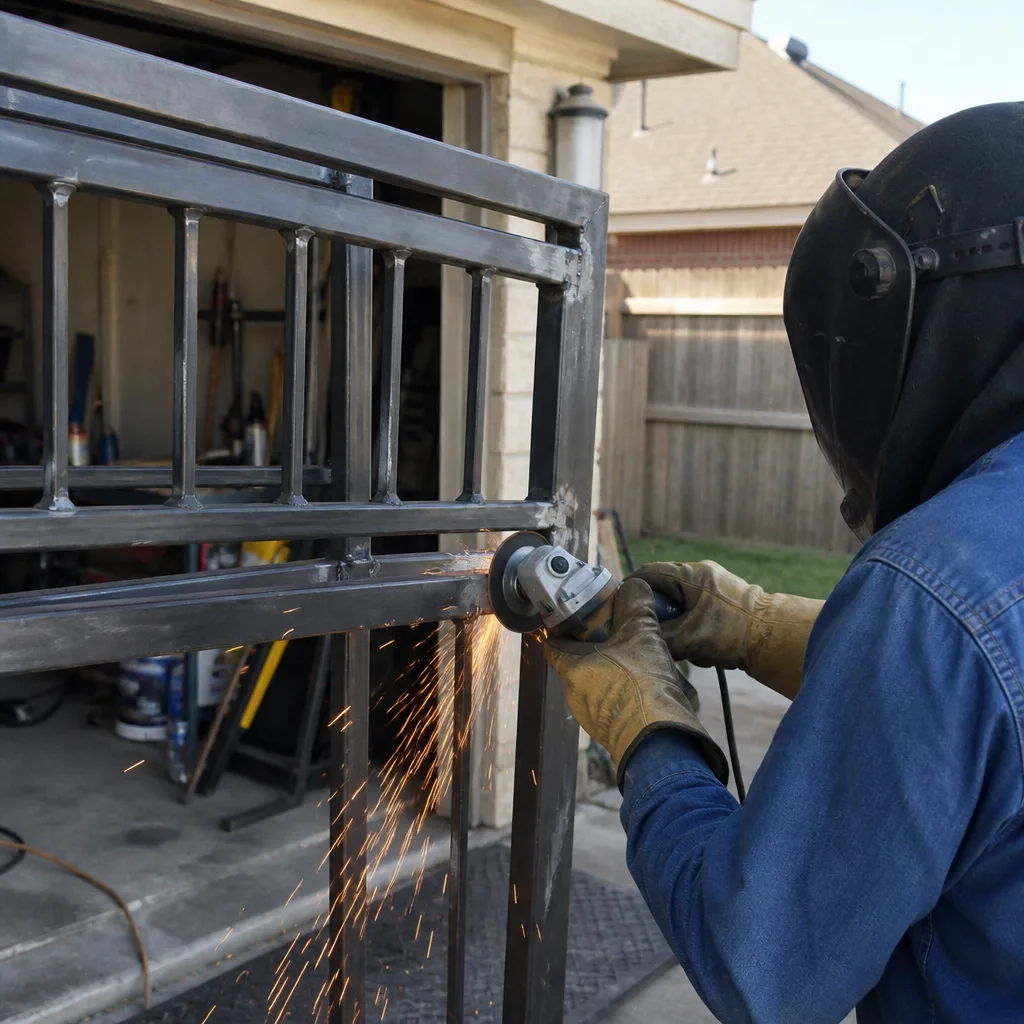
- Welding. Welding a cracked steel tube gate in your driveway requires a welder, a grinder, a generator, and eyes that know what a good bead looks like. This is not a weekend project.
- Post resetting in concrete. Digging out a post that’s set in concrete and reseating it plumb and level is a two-person job with a lot of heavy material. Get it wrong and the gate will sag again inside a year.
- Control board diagnostics and replacement. If you don’t know how to read a multimeter, don’t open the control board. You can fry a $200 board with a screwdriver slip.
- Electrical wiring between the opener and the house or solar panel. Low-voltage wire is forgiving, but if your gate runs on line voltage, call someone who knows the code in Denton County.
On-Site Welding vs. Bolt-On Patches
A gate sags in the hinge post, not in the middle, and that is where we start. When a steel gate frame cracks, or a hinge tears loose, you have two options: bolt a patch plate over the damage or grind it clean and weld it. The patch is cheaper up front. In North Texas heat cycles, it won’t last.
Here’s why. North Texas goes from 15 degrees in February to 105 degrees in August. That’s a 90-degree swing, and steel expands and contracts through every degree of it. A bolt-on plate is a mechanical connection. Under repeated thermal loading, the bolts loosen, the plate shifts slightly, and the crack underneath keeps growing. Within a year or two, the crack has spread beyond the plate and you’re back where you started, except now the metal is thinner and harder to weld cleanly.
A proper welded repair is a metallurgical bond. When done right, the weld is actually stronger than the surrounding steel. The key is in the prep: the crack must be ground out to clean metal, a root pass laid in, and then a finish pass on top. Skip the grinding and you get a weld sitting on top of paint and rust, which is cosmetic at best. Fix the panel without the post and you’ll fix it twice.
What to look for on a finished weld bead: the bead should be smooth and slightly convex, with no pinholes, and the area around it should be wire-brushed clean. A good welder cleans his work. We weld on site in Denton and the surrounding county, which means your gate comes off the hinges, gets fixed in your driveway, and goes back on the same day. We don’t haul it to a shop because we don’t need to. You can stand there and watch the work happen. You can even take notes for when you hire the next guy.
Gate Material Lifespans in North Texas
If you’re deciding between repairing a gate and replacing it, you need to know what that material is realistically good for. These numbers come from real gates we’ve inspected in Denton, Argyle, Sanger, and Krum, not from a manufacturer’s brochure.
- Wood gates (cedar, pine, or redwood): 8 to 15 years. North Texas sun and humidity are brutal on wood; we see cedar gates in Denton start to split and rot around year 10. The hardware usually outlasts the wood. If your wood gate is under 10 years old, a post replacement or hinge upgrade usually makes more sense than a full rebuild. If it’s over 15 years old, you’re nearing the replacement window, and Gate Installation in Denton is a conversation worth having.
- Wrought iron and ornamental steel: 20 to 40 years, if the welds hold and the paint is maintained. Wrought iron gates in Denton’s historic neighborhoods often outlive two or three openers. The weak points are the welds at the hinge side and rust at the base of the pickets. Both are repairable.
- Steel tube frame gates (the modern standard): 15 to 25 years for the frame, though the powder coating will show its age by year 10. These gates fail at the welds and at the bottom crossmember, where pooled water accelerates rust. Weld repair can add a decade to a steel tube gate for a couple hundred dollars.
- Aluminum gates: 20 to 30 years, with almost no rust risk. Aluminum doesn’t crack like steel; it bends. It’s also harder to weld in the field, which is why we recommend steel tube gates for most Denton properties. When aluminum goes, it usually goes at the hinges.
The honest takeaway: if your gate is less than 15 years old and made of steel or aluminum, repair is almost always the right financial call. If it’s a wood gate over 15 years old with significant rot, replacement starts to make sense. Either way, get a repair quote before you get a replacement quote. You can’t make an honest decision without both numbers.
How to Document Your Gate Problem for an Accurate Estimate
Here’s a simple system that will save you money and time. When you call a gate repair company in Denton, the person on the phone needs to know what they’re dealing with. If you can describe the problem in the language a tech understands, you’ll get an honest estimate on the first call instead of a vague “we’ll have to see it.” And if you can send photos, even better. We’ll give you a number before we ever roll a truck.
- Take three photos: one of the whole gate from ten feet back, one of the hinge or wheel area, and one of the opener unit with the cover off if you can safely do that. In Denton’s flat light, morning photos show gate problems best; midday sun creates shadows that hide cracks.
- Video the gate moving. Ten seconds, phone held steady, showing the gate opening and closing. If it’s making a grinding noise, catch that audio. Half of the opener diagnostics we do start with a sound.
- Describe what changed, not what you think is broken. “The gate started dragging on the driveway last week” is more useful than “I think the hinge broke.” You don’t need to diagnose it. You need to describe the symptom accurately.
- Note when it started. After a freeze? After the July heat wave? After the city did utility work near the street? Timing points to the cause. In Denton’s soil, a gate that starts dragging in August usually has a post heave problem, not a hinge problem.
- Get the opener brand and model. It’s on a sticker on the opener arm or housing. Ghost Controls, DoorKing, Mighty Mule, Elite, all different enough that knowing the brand cuts diagnosis time in half.
Twenty minutes of this up front will get you an estimate you can trust, from us or from anyone else. And if you’ve got a written estimate from another company, send it over. We’ll give you a free second opinion on whether it’s fair, whether it’s too high, or whether it’s selling you work your gate doesn’t need.
Gate Opener and Motor Troubleshooting
Automatic gate openers are the second most common call we get in Denton, right behind sagging gates. The thing to understand is that an opener that won’t move is not necessarily dead. In fact, in our experience, about half of the “dead openers” we see just need a limit adjustment, a cleaned sensor, or a new capacitor. Here’s how to think about it before you pay for a new Gate Motor & Opener in Denton.
If the opener hums but doesn’t move: the capacitor is the likely culprit. This is a $25 part on most Mighty Mule and Ghost Controls units and takes fifteen minutes to swap. If the motor is actually seized, that’s a different story, but a humming opener is usually a capacitor.
If the gate opens but won’t close, or closes but won’t open: check the safety eyes or the loop detector. Leaves, debris, or a misaligned safety sensor will tell the opener that something is in the way. In Denton, wind-blown leaves and the occasional armadillo trigger a lot of phantom obstructions.
If the gate stops short of the post: the limit switch is out of adjustment. This is a screw turn or a digital setting. Five minutes of work.
If the opener works intermittently: look at the power supply. Solar panels get dusty, battery terminals corrode, and line voltage can dip. An intermittent opener usually has an electrical supply problem, not a motor problem.
If the remote doesn’t work but the keypad does: change the remote battery, then check the antenna wire on the control board. If a DoorKing or Elite opener’s antenna has been chewed by a squirrel, the remote range collapses. We see this a lot in Denton’s older trees.
We service all nine major brands: LiftMaster, FAAC, BFT, Linear, Viking, Ghost Controls, DoorKing, Elite, and Mighty Mule. If you’re not sure what you have, snap a photo of the opener and the sticker and call. A live person answers, day or night.
Common Mistakes to Avoid
- Replacing the gate before checking the post. This is the most expensive mistake we see in Denton. A sagging gate usually means a post that moved in the clay, not a gate that went bad. Fix the post for a few hundred dollars and your existing gate works fine.
- Bolting a patch plate over a cracked weld. It’s a temporary cosmetic fix. In North Texas heat cycles the crack grows under the plate, and by the time the gate fails again, the metal is harder to weld cleanly.
- Ignoring a noisy opener. Grinding is friction. Friction is wear. Catch it early and you spend $40 on parts. Let it grind for a year and you’re replacing a drive assembly for $300 or more.
- Buying an opener without checking compatibility with your gate’s weight and swing. A Mighty Mule that works great on a light walk gate will burn out in a year trying to move a 400-pound driveway gate. Match the opener to the load.
- Setting posts in concrete without a proper footer in Denton clay. Concrete poured directly against expansive clay will crack when the soil moves. We use larger footers and sometimes gravel to account for the heave. Skimp here and you’ll be fixing the same post in three summers.
- Accepting a phone quote that spikes at the door. In Denton and everywhere else, the honest companies quote upfront and hold their number. If someone gives you a range on the phone and a bigger number at your gate, you’re not working with a company that values its name.
When to Call a Professional
Any gate that involves a torsion spring, a line-voltage electrical connection, or a structural weld is a professional repair, full stop. Those are the jobs where a mistake costs more than a gate; it costs fingers or a fire. Beyond that, call a pro when you’ve tried the simple fixes and the gate still isn’t right. A sagging gate that persists after hinge adjustment usually signals a post problem in Denton’s clay. An opener that trips its breaker repeatedly isn’t going to fix itself. And if you’re not sure whether to repair or replace, get an honest opinion rather than a sales pitch. Gatewood Fence & Gate offers a free second opinion on any written estimate in Denton, call (940) 394-8744 and someone will pick up the phone.
Frequently Asked Questions
Most gate repairs in Denton run between $90 and $400, covering hinge replacement, wheel swaps, opener tuning, and minor weld repairs. Post resets are the higher end at $200 to $500. The price is quoted and agreed before any work starts. Call (940) 394-8744 for a free estimate on your specific gate.
Yes, a call answered by a live person is the first step, and we keep repair slots open for same-day and emergency calls throughout Denton and the surrounding county. If your gate is stuck open or your driveway is blocked, we treat that as an urgent call. Call (940) 394-8744 and explain what’s happening.
If the gate frame is sound and the post is solid, repair is usually the right call. Look for a straight top rail, intact welds, and a post that doesn’t move when you push the gate. If the frame is rusted through in multiple places or the post is rotted at the base, replacement starts to make sense. Get both quotes before you decide. We’ll give you a free second opinion on any written estimate for a Denton gate.
Yes. Denton sits on expansive clay that swells with moisture and shrinks when it dries. Posts set in that clay can heave and shift seasonally, which makes a gate drag or bind. We see it every summer, and the fix is a proper post reset with a footer designed for clay movement, not a new gate.
We service LiftMaster, FAAC, BFT, Linear, Viking, Ghost Controls, DoorKing, Elite, and Mighty Mule. If your opener brand isn’t on that list, call anyway, most of the mechanical parts are common across brands, and a live person can tell you over the phone what’s likely going on.
Yes. We bring the welder, grinder, and generator to your driveway and repair the gate where it hangs. The gate comes off the hinges, gets welded, and goes back on the same day. No hauling, no shop delays, and you can watch the work happen. Call (940) 394-8744 for an estimate.
The Bottom Line
Most gate problems in Denton trace back to three causes: clay-heavy soil moving posts, heat cycles cracking welds and loosening hardware, and openers that never get basic maintenance. Learn to identify these, and you’ll save yourself from a gate replacement you never needed. For more guides & resources, visit our blog. Fix the post, not just the panel. Weld the crack, don’t patch it. And when you call for help, call someone whose name is on the shop, someone who answers the phone, someone who quotes the price the gate will actually cost. That’s how we’ve done it in Denton since 2001.
Call Gatewood Fence & Gate at (940) 394-8744 for a free estimate on any gate repair in Denton. A live person answers, the price is upfront, and every job carries the 90-Day Done Right Promise in writing.
Written by Hal Gatewood, Owner at Gatewood Fence & Gate, serving Denton since 2001.